Wednesday, July 13, 2011

Hazem Mohamed Elshafee


Hazem Mohamed Elshafee is one of about twenty Egyptian adults who come to the Al-Kayan community center in Cairo twice a week for English classes that I teach with several other DukeEngagers. He was born in Kaluobia the biggest city near Sinduon, the village where he grew up. Very interested in learning and tradition from an early age, he enjoyed village life immensely. Hazem's eyes glow when he reminisces about village tea brewed over a wood fire, far superior to the city tea here in Cairo. As a child he fondly remembers wandering the family farm with homemade slingshots. Sinduon is a large enough village that Hazem was able to attend schools close to home through secondary school. He frequently returns to the village to visit family, celebrate high holidays, and check up on the family farm.

Hazem left the village to attend 6 October University where he studied Mechotronic Engineering, a combination of Mechanical and Electrical Engineering. He now works for the Cairo Metro as a maintenance engineer. After one of our first classes together he walked with us to El-Demerdesh metro station. I turned away to buy a metro ticket, and when I looked back Hazem had deftly removed the covering of one the defunct mechanized turnstiles. Within a minute he had run a complete diagnostic and with a few adjustments to the whizzing belts and circuits, the turnstile was functioning once again.

Hazem is always bright and engaged. He’s very excited about improving his English, and it’s apparent that he invests himself fully in everything he chooses to undertake. He’s a jokester and he always has a giddy laugh brewing just under the surface.

Like most Egyptians, he has mixed feelings about the Revolution. Mubarak had been in power for almost his entire life until the Revolution, and Hazem is part of the generation (those now in their 20’s and 30’s) most negatively affected by the failures of the old regime. So the idea of change and Mubarak’s departure are exciting prospects for him. Nevertheless, he is uncertain of the Revolution's future as of July 9. The protests now feel more like festivals, with families and lovers strolling leisurely through the square as vendors sell sweets and t-shirts. He wants to see Egyptians developing and executing plans for a better future while simultaneously protesting for democracy and restitution. He sees some Egyptians using the protests as an alternative to more practical means of improving their situations; they wake up, grab a blanket, and head to Tahrir, rather than going out to find work. Nevertheless he recognizes that many of these protestors are without any alternative recourse.

I’ve really enjoyed getting to know Hazem as both his teacher and his friend. We both like trading stories about our native cultures and experiences in our very different homes. Yet all things considered, I watch him moving through life day-to-day as I would expect any of my American friends to if they were operating with and in the same cultural and historical background and context. Hazem thinks that the internet should be restricted in some ways, and he would be uncomfortable wearing shorts in public, but ultimately he is motivated by his love of God, family, and country. He dreams about a better future as an individual and for Egypt collectively, and he pursues those dreams with optimistic ambition. I admire his determination, extraordinary work ethic, and above all his propensity for laughter and celebration of the simple parts of the human experience that make our seemingly mundane lives extraordinary.

Some pictures I stole from Veronica Fournier, a fellow DukeEngager


Day trip into the city with the kids from Ana Al Masry

Head stand competition with Ahmed at Al-Azhar Gardens

Forum on the United States' Involvement in the Egyptian Revolution at Cairo University

Outside Ana Al-Masry

American/Egyptian Fusion jam band playing a few blocks from our apartment

Wednesday, July 6, 2011

The Question of Privilege


So I finally have the time to blog again-- now that I’m stuck in the apartment with food poisoning. I don’t know whether it was the ful and falafel sandwich from a very local hole-in-the-wall restaurant, the week-old pizza and dipping sauces that I faithfully enjoyed to the end (holy relics of my long-lost country’s cuisine), or just the fact that I rarely wash my hands between playing with the street children and eating the food they prepare for us in the desert. Regardless, I’m enjoying the break, despite the frequent trips to the bathroom.

Driven by hunger and my ancestral instinct to hunt and gather, I left the apartment mid-day today to forage for some food. In the course of my brief foray (the food poisoning has me on a short timetable), I saw a gattling gun mounted to the back of a pick-up truck, protestors camping in Tahrir square, and children sleeping in gutters along the side-streets. Then I found and devoured a McFlurry.

When we talk about third world countries, I see images of huts in Africa, nomads in the desert, or rural villages in South America. It’s disconcerting to see third world poverty and disorganization in a country where everyone wears jeans, owns a cell phone, and watches American movies.

During our first week in Cairo, I met one of the arsonists who set the National Democratic Party HQ on fire in Tahrir during the protests earlier this year. He’s my age, and he wants the same things I do: a solid education and the opportunity to work hard to build the future he dreams of. Due to forces out of our control, I found myself in America where I very much have those opportunities, while he was born in Egypt without the means for a stellar education at a time when a quarter of people 20-30 years old are unemployed.

How do I reconcile with the fact that while I'm on an all-expenses paid trip with my world-renown university, he is choking on tear gas and dodging rubber bullets because he has no hope for a better future in the world as he knows it? We were born into vastly different life experiences. The spectrum of possible reactions ranges from sickening guilt to ambivalent acceptance. Surely he protests for the right to the lifestyle I enjoy, so why not enjoy it? Yet in some way, I feel that that acceptance cements my privilege at the expense of his.

I like what our professor, Mbaye Lo, shared with us the other night. He said that as his father dropped him off for his first day of school, he told him, "this education is not for you to get a job, but for you to help those who cannot help themselves." The privilege I was born into has afforded me an education, like most of you reading this blog. The education we have does not denote any type of superiority and inferiority, but rather a disparity in opportunity. We may not be in control of where and what we're born into, but we are responsible for our ensuing actions. It is easy to come to terms with the third world from outside of it, but I invite you to consider how unsettling it can be from within.

Friday, June 24, 2011

Garbage City and the Zabaleen


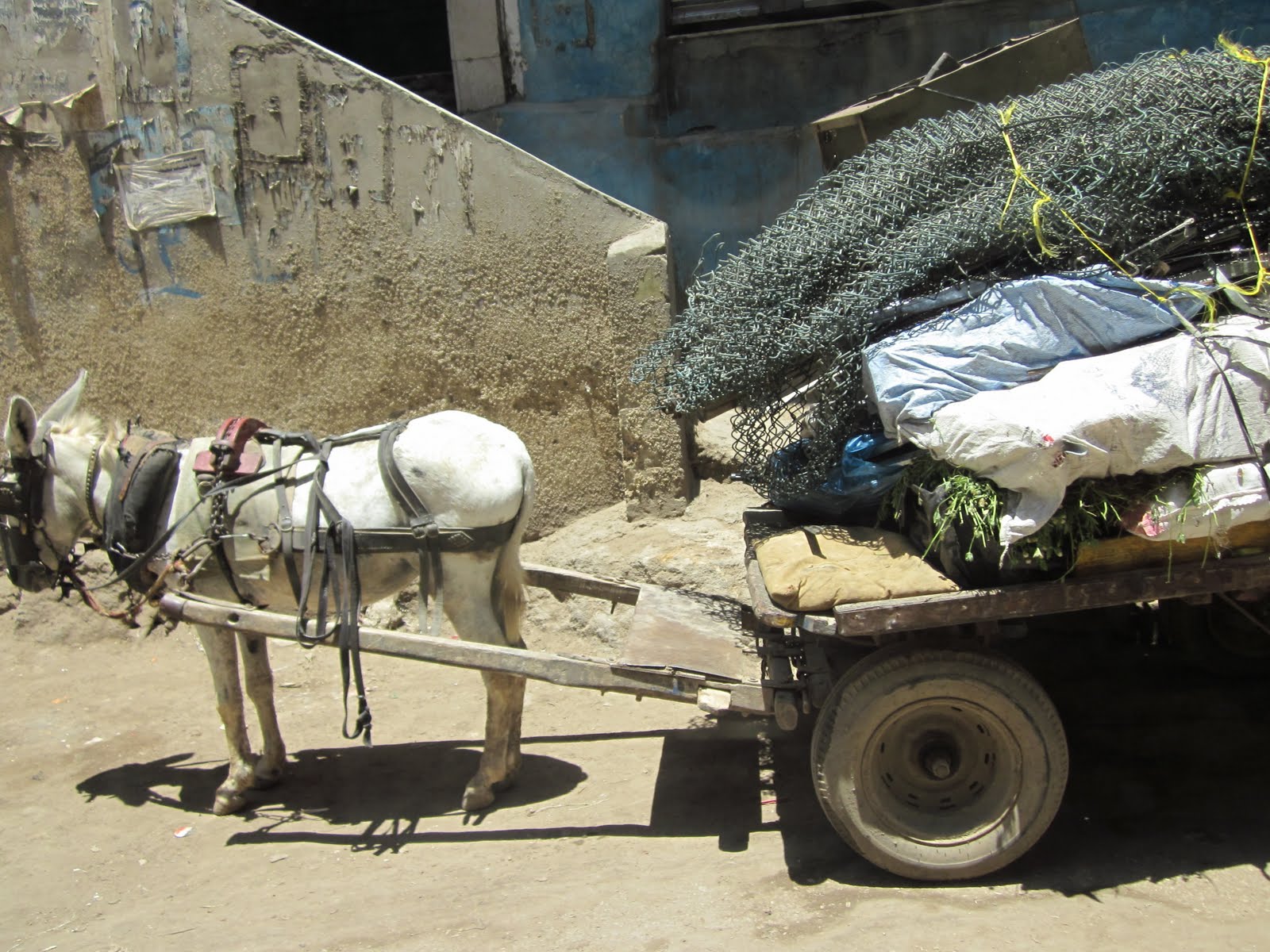
Last week we went to “Garbage City.” Collecting garbage is a business in Cairo. Garbage collectors make a living by selling the recyclables they find in the trash. Over the past century, the Zabaleen have established themselves as the city’s garabge collectors. The Zabaleen used to be a nomadic tribe of Christians, who, unlike Muslims, could keep domesticated pigs. When several members of the tribe settled in Cairo, they found that they were better suited for collecting trash than the Muslims doing so at the time, because their pigs could dispose of the organic waste as they sorted through it for recyclables. Now the Zabaleen are the city’s garbage collectors. Like the Mafia, different areas in Cairo are controlled by different families, and there are turf wars when groups collect outside of their territory. With donations from upper class Christian communities in the suburbs around Cairo, a church was built in a huge natural cave in the Zabaleen neighborhood. The Zabaleen are often involved in fights with Muslims from other poor neighborhoods. Largely uneducated and living in absolute squalor and filth, the Zabaleen are scrappy street fighters, sometimes identified by cross tattoos on their arms.


I’m still coming to terms with the images from our visit. Trash was in piles two to three stories high—inside and outside. People of all ages sat in repulsive piles of garbage, sorting out plastic and cardboard as millions of insects swarmed around them. Children hopped along trash piles spilling in and out of houses, laughing and coughing. And despite these conditions, people seemed more happy and friendly here than any area we had visited thus far. I think a lot of it can be attributed to their excitement at seeing foreigners in a place that seldom receives visitors of any kind.


Most of all, it was striking to see yellowing posters of Jesus and the Virgin Mary hanging on peeling wallpaper above piles of garbage when all my life their pictures have been in elaborate churches surrounded by average American neighborhoods that would appear as absolutely fantastical palaces to the Zabaleen.

Mosques, some Churches, and a Synagogue


For me, one of the most significant parts of this trip has been observing the religious culture of Cairo.

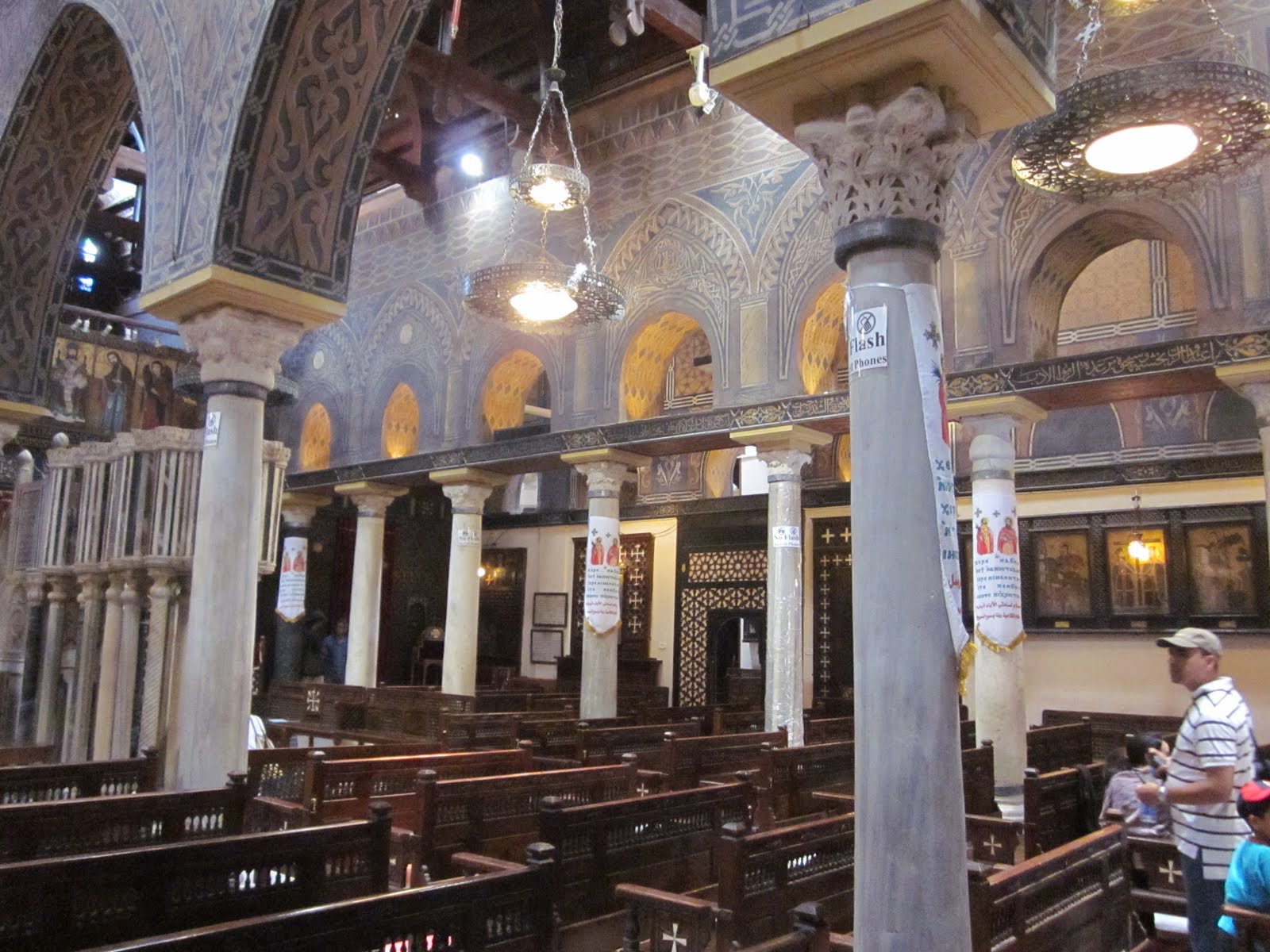
Muslims are by far the majority; Cairo is known as the city of a thousand minarets because there are so many mosques. Christians compose a small but potent minority (I’ve heard 7-10% of the population). Jews are few and far between. Egypt has a rich history of varying religious movements, and Cairo presents a physical record of this religious transition. There are hundreds of beautiful mosques and churches, each with a story.


Many of the stories I’ve heard as we’ve visited these sites are charged with polemic. At the first church we visited, our Christian guide explained all the subterfuge that the church’s founder had to overcome from a conniving Rabbi turned Muslim. Another day, at a Shiite mosque with a Sunni guide, we heard stories of the Shiite founder’s mental illness and the Shiites current delusional practices of reverence. The histories of these places of worship have been rewritten to forward the religious beliefs of those telling the stories. I don’t doubt that there is some truth in the stories we heard, but almost always the presentation concluded in a way that rendered the beliefs of “the other” as virtually unpalatable.


In America, social pressure often pushes people (and conversation) towards secularism rather than religion. In Cairo, exactly the opposite is true. It seems like people are programmed to wax religious in every aspect of life. It’s jarring to go from a country where it feels like a social risk to share your beliefs, to a country where people reference God in virtually every conversation. People even brand themselves. Many Muslims have a large bruise on their forehead from frequent prayer. To some it is a badge of piety. And most Christians here tattoo small crosses on their wrists.


I’ve been asking about Egyptians’ views on recent tensions between Muslims and Christians a lot. I’m still processing through all the responses I’ve been receiving, but hopefully that will be a blog post of it’s own soon.

Wednesday, June 8, 2011

The Sufis

Tonight I had the opportunity to listen to a group of Sufi musicians in a small venue not far from our apartment. Sufis seek God through ritualistic music and dancing. Their belief system is inherited from Islam, but they often focus on mysticism more than traditional Muslim communities. Warm, yellow light hung low in the incense-thick air, disappearing into the dark corners of the ceiling. The intricate patterns on the rich red rugs snaked beneath the six Sufi musicians against the wall. It was hot, but it felt right to be sweating as I listened to the tribal rhythm of the drums and the airy whistle of the Nay flute. One Sufi would lead each song, drawing their voice into the room between flourishes from the flute. Then with whirling and excited accents from the drums, the whole group would join in with strong voices, reverberating through the small chamber. Around the room, those listening had all contracted the rhythm of the Sufis, swaying, dancing, or clapping. There was connection—and communication that supersedes verbal exchange.


Earlier in the week I attended a performance of traditional Arabic music at the Cairo Opera. Up in the back of the highest balcony, compulsory tie from the ticket box around my neck, I looked down on the National Symphony and the elite Cairenes nestled on the floor before them. As the lush swell of strings filled the room, chests around the room swelled with pride. The well educated and powerful leaned forward in their seats and rocked with the coursing symphony, tapping the dancing rhythms of the violins and Qanun.


And then there was a moment this morning: I sat in a drum circle with five boys at Ana Al-Masry, an NGO that serves street children in Cairo. This week has been the first time many of these boys have experienced structured musical education. As we locked into rhythm, I watched them engage emotionally in the beat we had finally learned. The walls pulsed with the booming of the drums, and the music became the most tangible thing in the room.


The Sufis are on to something. Music is spiritual. As humans, we need purpose beyond survival, we find beauty in sunsets, and we experience stimulus through music that goes beyond and outside of all our other daily experiences. Music has always been an escape for me. There’s movement in music that you can surrender to, you abandon control and let it take you where it will. There are things that need to be communicated and explored, and when words fail, music exceeds expectations. This is human. In many ways, the Rock music that has been my escape—driving bass, fast, hard drums, and strident electric guitar—is just a modern adaptation of the writhing pulse of the Sufi music that has inherited the tribal beats of ancient people. And that beat unlocked something in the children at Ana Al-Masry this morning.


--------


One of the differences I’ve noticed between Western and Eastern music is the way a song is ended. In Western music, there’s often a grandiose swell as the music slows and the musicians linger on each note. In the Eastern music I’ve experienced so far, the music frequently speeds up as the end approaches, then everything abruptly stops.

As the Sufi musicians approached the end of their songs, volume and tempo would frantically increase until the room sounded like it would wrench apart at any minute, then suddenly there was silence… and a new song would softly begin. It seems fitting that the music of Egypt would transition like that. In the streets of Cairo, outside the sweaty building housing the Sufi musicians, is a society just rounding such a transition. The hot pressure of unrest rose until a surging revolution released it. And now the city seems to be cooling, though maybe only temporarily, as a new era for Egypt begins.